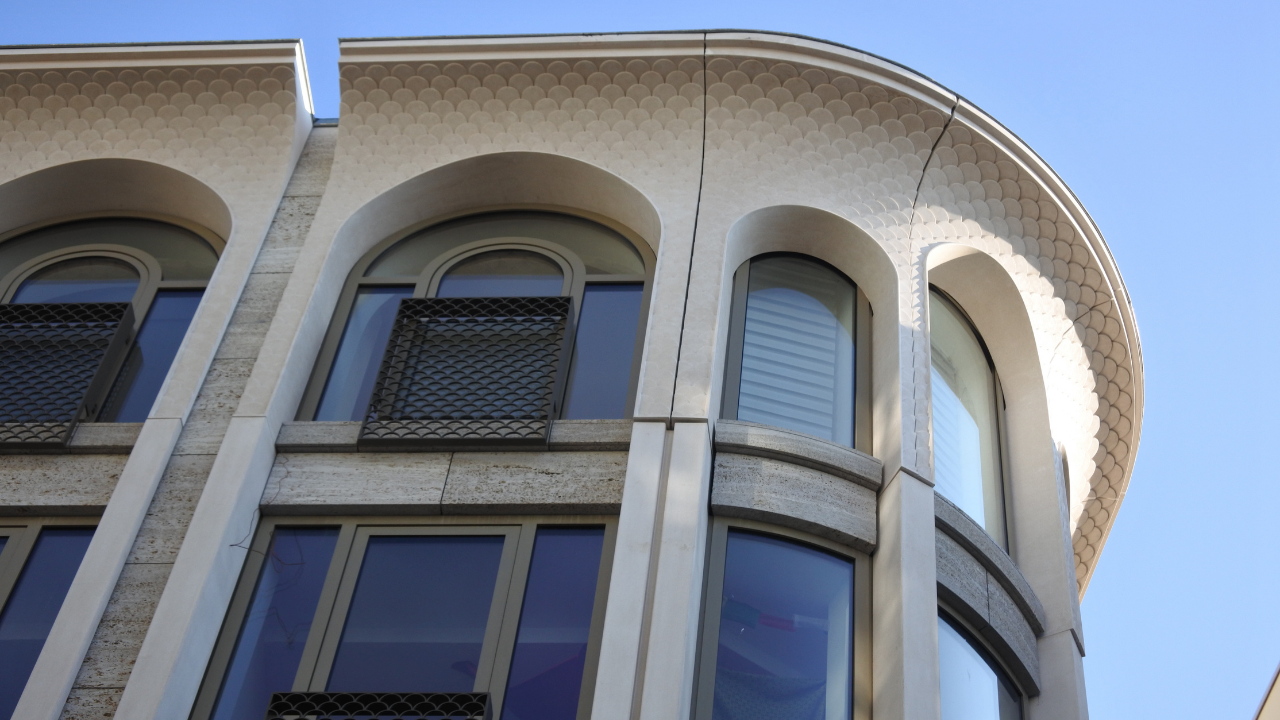
In 2019, a 1970s shopfront on Amsterdam’s Kalverstraat underwent a striking transformation. Its most distinctive feature, a curved corner with an intricate scale pattern, was created using Acrylic One (A1), a material used in facade applications since 2000.
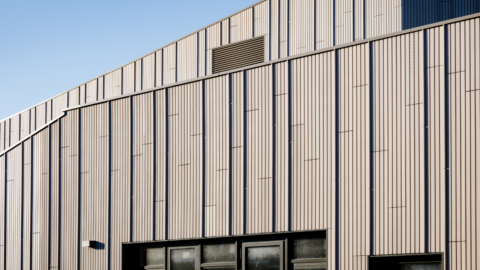
Before the refurbishment, the LEGO Store at Kalverstraat 57 had a plain, industrial facade. The windows remain in their original positions, but everything surrounding them has been redesigned. White columns rise approximately seven metres from street level, while the upper corner curves around the building in finely detailed, scale-patterned elements. It was designed by architectural practice Rijnboutt. The practice was responsible for the design, technical detailing and aesthetic supervision.
Manufacturer Poly Products used CNC milling to produce the moulds, incorporating both the curvature and the scale pattern. A1 was then laminated into the moulds with glass-fibre fabric, creating open-backed elements with a total thickness of approximately 7 mm. Weighing around 15–20 kg/m², the elements were light enough to be supported by the existing building and manageable during installation. Achieving the same combination of form, weight and fire performance with other materials would have been challenging.
Each project begins with the design rather than a standard set of dimensions.
Glass Reinforced A1
A1 is a mineral-acrylic composite consisting of a mineral powder and a water-based acrylic resin. When reinforced with glass fibre, it is known as GRA1: Glass Reinforced A1. The name positions it alongside two materials familiar to architects. Glass-reinforced plastic (GRP) offers low weight and considerable design freedom, but fire performance can be a challenge. Glass-reinforced concrete (GRC) performs well in fire but is heavier. GRA1 combines low weight and freedom of form with an A2-s1,d0 reaction-to-fire classification under EN 13501-1 when sand is added to the mix.
A1 is not intended as a universal replacement for either material. It is unsuitable for permanently wet details, horizontal ledges or load-bearing components. Its strengths lie in applications that demand complex forms, fine detailing, low weight and compliance with stringent fire requirements.
Each project begins with the design rather than a standard set of dimensions. A local manufacturer produces the elements using moulds made to suit the proposed design. Acrylic One supports architects, facade contractors and manufacturers throughout this process, from initial design reviews and material samples through to the first mock-up. Design values based on the Eurocodes are available to support structural calculations.
At Future Facade 2027, Acrylic One will showcase the LEGO Store alongside other facade projects, ranging from reproductions of historic architectural features to concrete-effect panels.
Visit AcrylicOne in hall 4, stand C001.