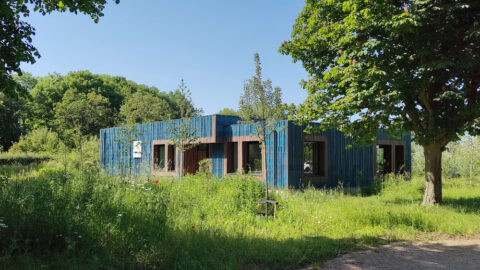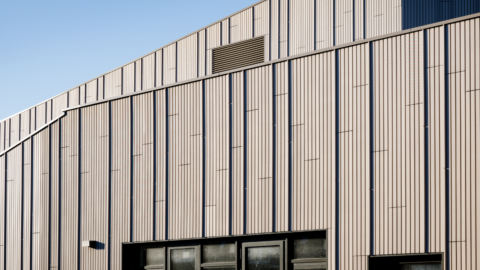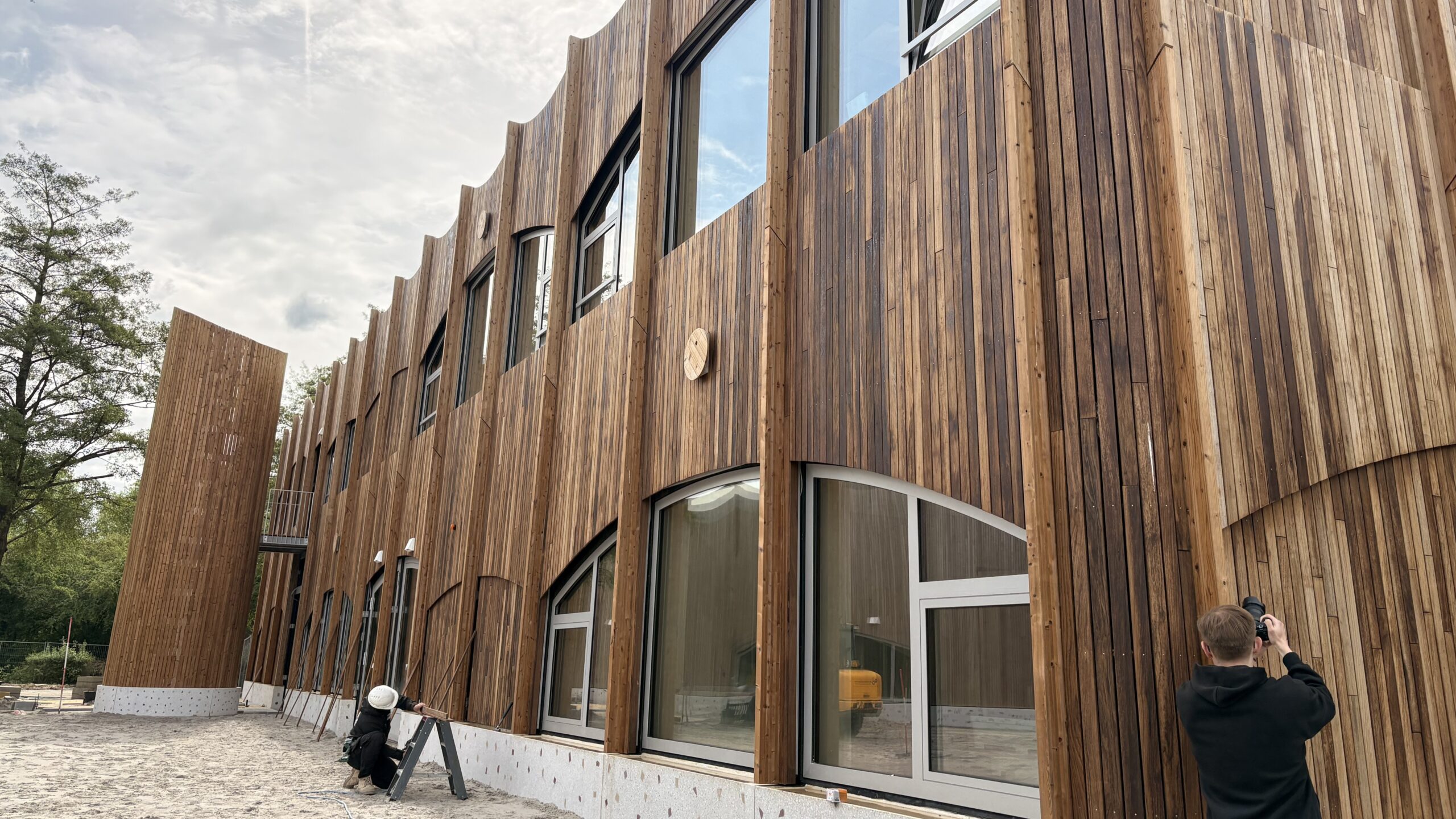
Architectural practice Zoetmulder designed a child centre in Houten and chose sustainable materials throughout. The timber facades with their arched windows immediately stand out. The outdoor area will soon be landscaped with play areas, a kitchen garden and swales.
The new building accommodates a day nursery and a public primary school. The child centre has recently opened and the first reactions have been enthusiastic. Speaking about the distinctive facade, Elise Zoetmulder says: “Timber is a wonderful material to work with, both in terms of its physical properties and the experience it creates. The building’s floor plan is almost square, making it very compact. If you were to build this in brick or concrete, it would result in a rather cold and rigid structure.
With timber facades, which are also arched at the top, the appearance becomes much friendlier. The vertical interruptions in the facade reinforce this effect, while the timber turrets – each facade has one – add a playful character. Thanks to the use of timber, De Velduil has a truly distinctive identity.”
Timber samples
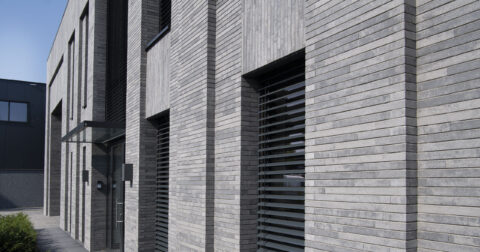
“To determine which timber species we would ultimately use, we requested a large number of timber samples, laid them side by side and compared them,” explains colleague Anton Zoetmulder. “We considered both cost and aesthetics. We found the thermally modified fraké timber particularly attractive, and when it turned out that the supplier also offered poplar and spruce within the same range, we decided to proceed with that option. In the end, we selected a combination of fraké and spruce.
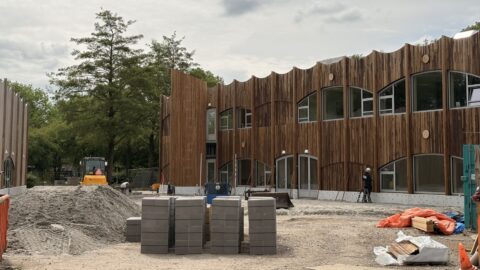
Photo: Thomas van Belzen
The client was equally enthusiastic, not only because of the appearance but also because thermally modified timber is highly resistant to decay and therefore requires very little maintenance. The facade cladding is made of dark-coloured fraké, while the vertical beams along the facades and the turrets are made of spruce, which is lighter in colour and somewhat knotty.”
Guaranteed quality
The process of thermal modification is carried out to alter the cellular structure of the timber. As a result, the nutrients that fungi and insects rely on are removed, making the risk of timber decay almost negligible. Thermally modifying timber – through steaming – also makes it dimensionally stable and very lightweight. Spruce is naturally a very soft timber species and, when untreated, is not suitable for outdoor use. Thanks to the modification process, however, spruce becomes a high-quality material that can be successfully used in external facades.
The facade cladding of De Velduil Child Centre is open and therefore naturally ventilated. “The facades are separated from the insulation layer and inner wall construction so that air can circulate freely,” explains Elise Zoetmulder. “This allows the timber to age more attractively and ensures that its quality is maintained for a very long time – up to fifty years. An additional benefit is that it created greater depth within the facade, making it easy to incorporate nesting boxes for bats and certain bird species. We were also able to integrate the solar shading for the arched windows within this cavity.”
Educational value
A broad plinth runs along the base of the timber facades. The plinth is made of concrete containing bricks reclaimed from the former school building. “It is not biobased,” says Anton Zoetmulder, “but it is a form of reuse that provides a nod to the past.
There is another aspect to it as well: small channels have been incorporated along the top of the plinth beneath the windows. These retain water when it rains, and when the sun comes out the water evaporates, providing additional passive cooling. Although it is difficult to calculate the exact efficiency, it certainly has an effect. Moreover, the principle itself is educationally valuable; children can learn from it. The same applies to the swales, the nesting boxes and many other features. They all offer opportunities for discussion and learning in the classroom.”
Fire certification
Because of De Velduil’s open cladding system, obtaining the necessary fire certification proved to be quite a challenge. Anton Zoetmulder explains: “With a closed facade, the assessment focuses solely on the exterior surface and the calculations are relatively straightforward. For the open cladding system used in this project, however, very specific calculations had to be carried out regarding the spaces between the boards, as well as the cavity between the inner wall, the insulation and the cladding.
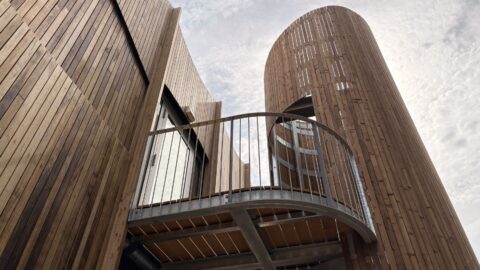
Photo: Thomas van Belzen
The vertical beams along the facades consist of multiple sections and are therefore laminated. This created an additional certification challenge because the fire classification of laminated timber differs from that of solid, non-bonded timber. An additional report was therefore required in order to obtain the fire certificate. Extra fire stops were also incorporated within the timber frame structure. Considerably more steps were required, and during the construction phase this was certainly a tense process. In the end, however, everything was successfully completed.”
Positioning on the site
Bureau Zoetmulder aimed to design an energy-neutral building. “That starts with reducing energy demand,” says Anton Zoetmulder. “A well-insulated building stays cool in summer and warm in winter. The child centre has a compact design and only limited roof space. With the photovoltaic panels installed on the roof and the enhanced insulation values of the facades, floors and window frames, we achieved exactly the required performance.”
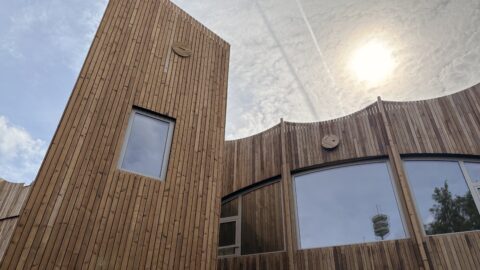
Photo: Thomas van Belzen
Elise Zoetmulder adds: “The child centre has a compact, almost square floor plan and has been positioned on the site so that its corners, rather than its facades, face south, west, north and east. As a result, no facade receives full sun throughout the day, nor is any facade completely deprived of sunlight.
This reduces heat gain and heat loss through the building envelope, benefiting both the comfort of the occupants and the energy bill. A number of mature trees are located on the southern side of the site, which also help to keep the child centre cool. All in all, this has been a highly successful project that we are very proud of.”

This article was published by Bouw en Installatie Hub. Would you like to stay up to date with the latest news from the construction and building services sectors? Then visit the Hub and sign up for the online community.
↗