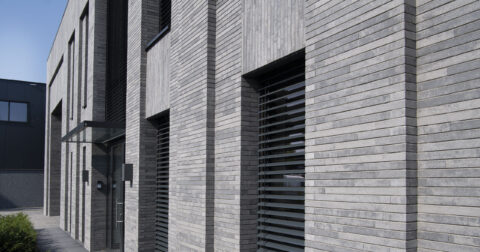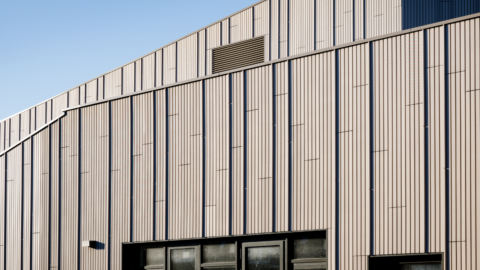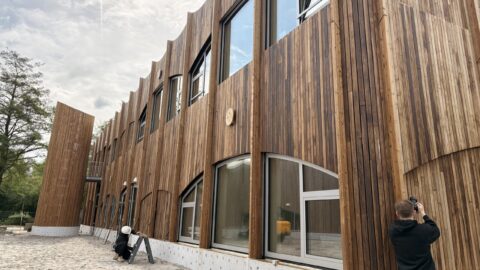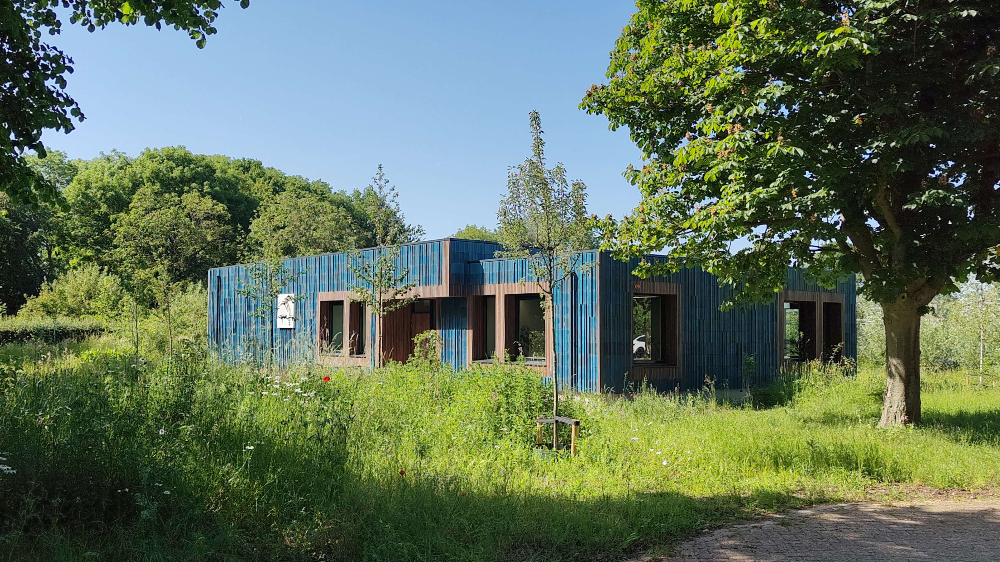
A facade made from used and screened toilet paper. The building belongs to Hoogheemraadschap De Stichtse Rijnlanden, which recovered the paper from its own wastewater treatment facilities. Now that’s something to be happy about!
Architect Jeroen Schoots and his colleagues at architectural practice Open Muur designed the unique facade panels, made from the equivalent of 2,000 rolls of flushed toilet paper. A facade made from toilet paper may sound unusual, but this showcase demonstrates that it can be a beautiful solution. The panels give the water authority’s office in De Meern a unique appearance.
Jeroen, facade panels made from used toilet paper. Is this a first?
“Yes, using screened material like this is a first. Reusing toilet paper achieves two things at once: it significantly reduces CO₂ emissions and cuts down on a considerable amount of waste. Every year in the Netherlands, we flush around 180,000 tonnes of toilet paper down the toilet. That paper contains cellulose, a valuable biological raw material. Cellulose is a major component of trees and plants and an important raw material for producing paper, including toilet paper, and cardboard. It also has applications in construction, including as insulation material. But once recovered through screening, it can also be pressed into excellent facade panels.”
How did you become involved in the project?
“Hoogheemraadschap De Stichtse Rijnlanden (HDSR) asked us to develop a sustainability programme for several buildings at its wastewater treatment facilities, including a number of offices. We looked at different ways of making those buildings more sustainable, and during our preliminary research we discovered that screened material was being recovered from the process at one of the treatment plants. We put two and two together: how great would it be to clad the facades with a product made from their own recovered raw materials?”
And what happened next?
“HDSR was enthusiastic and took the initiative to develop the idea further and turn it into a practical solution. Extensive research was carried out into both the quality and appearance of the final product. We designed the panels for the facade of the building in De Meern, and Nabasco produced them.”
Your website says: ‘Our designs are surprising, sustainable and created with enthusiasm.’ How does that apply here?
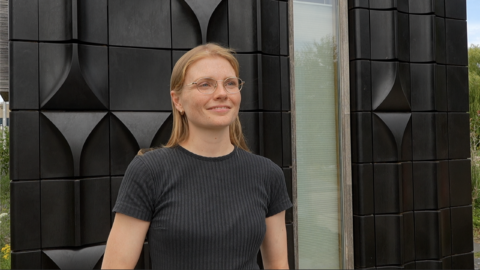
“The HDSR office in De Meern ticks all those boxes. It is surprising both in terms of its appearance and the raw material used. The panels have a textured surface and are blue. As a result, the building, which has a facade area of 200 m², has been given a distinctive and unique appearance.
“It is sustainable because this solution saves ten tonnes – or 75% – of CO₂ emissions compared with a brick facade. That is equivalent to preserving ten trees.”
And what about the enthusiasm?
“These facade panels demonstrate that sustainability, circularity and technically advanced applications can not only work very well together, but can also look beautiful. For me personally, that is a huge motivation. We need innovations like these if we want to move towards a much cleaner construction industry.
“Traditional construction materials – and their production – generate far too many emissions. We are experiencing the consequences right now [Jeroen and I are speaking on 25 June, when it is around 33°C outside, MdG]. Things need to change, and products like these can be part of that change.”
Did you ever imagine that you would design and use facade elements made from screened toilet paper?
“Haha, not specifically, but I don’t actually think it’s that strange. It has always been my ambition to contribute to innovations like this. Of course, it was fantastic that this opportunity came along, and we took it very seriously.
“I’m extremely proud that we were able to realise this project in collaboration with the various parties involved. I see quite a few initiatives (at Dutch Design Week, for example) that ultimately never progress any further. That’s such a shame.”
What is needed to make these innovations succeed?
“The main challenge with innovations is that they need to be actively driven forward. You need real-world examples that create momentum. That increases demand for the product, which in turn stimulates production.
“So it’s important to draw attention to a product or project like this. That also helps it reach investors who may be willing to invest in it. Production can then increase and prices can come down. It really is a flywheel effect. You also need clients with courage and vision, like HDSR.”
Is that starting to happen?
“We’re working hard on it. At the moment, we’re developing designs for several schools. As architects, we can give this type of panel a very distinctive identity.
“In the 1930s, new construction materials suddenly became available, which gave architecture an enormous boost. My aim is to create a similar effect today: to use new materials to develop a new, modern form of architecture, with a very clear focus on sustainability.”
What role could these facade panels play in achieving that ambition?
“I see opportunities in non-residential construction, particularly schools and offices. A facade made from these panels can be a fantastic means of architectural expression. These aren’t standard, ready-made panels rolling off a production line. The material is pressed into moulds, which means the possibilities for variation are almost endless.
“Within the dimensions of the mould (90 x 90 cm) you have complete freedom. It adds a new layer, a new dimension. You can create patterns or reliefs, or even mix in small stones or shells, for example, allowing the facade to tell its own story.”
What story does the HDSR office tell?
“The story of water. A blue pigment was added to the pulp, so from a distance it’s mainly the blue colour that catches your eye. As you get closer, you start to discover details of dykes and waterways in the relief of the facade.
“I think the subtle execution combined with a clear message works very well in this case. In principle, of course, you could press logos, slogans or all sorts of other things into the panels, but a facade isn’t an advertising billboard.”
Why does this innovation make you so happy?
“I have children, and I want to make the world a better place. I want to contribute to the solutions that we, as a construction sector, need to work on. There is a lot of scepticism, even though it is crystal clear that things really do have to change.
“Globally, construction materials account for 13% of total CO₂ emissions, while the sector consumes around 50% of all raw materials. Those are significant figures. I do everything within my power to make my own contribution; in this case, with facade panels made from screened material.”
Are you working on any other innovations?
“Timber construction is a major focus for us, particularly when combined with passive building principles. By making the building envelope and insulation as high-performing as possible, you can significantly reduce energy demand.
“With the electricity grid at risk of becoming overloaded, and already facing congestion in some areas, this can help solve several problems. It reduces demand for electricity, requires less maintenance and results in lower emissions. There are plenty of reasons to pursue it.”
This project earned Hoogheemraadschap De Stichtse Rijnlanden a nomination for the Water Innovation Award.
About Vrolijk Bouwnieuws
Do you have construction news that puts a smile on your face? And would you like to share it with the rest of the world? Don’t hesitate to get in touch and email our editorial team.
Looking for more Vrolijk Bouwnieuws? You can find it here.

This article was published by Bouw en Installatie Hub. Would you like to stay up to date with the latest news from the construction and building services sectors? Then visit the Hub and sign up for the online community.
↗